


Perception Gaps and Inclusive Practices in Higher Education: An Empirical Study at Veracruzana University, Mexico
DOI:
https://doi.org/10.58210/ri3698Keywords:
inclusive education, higher education, Disability studies, MexicoAbstract
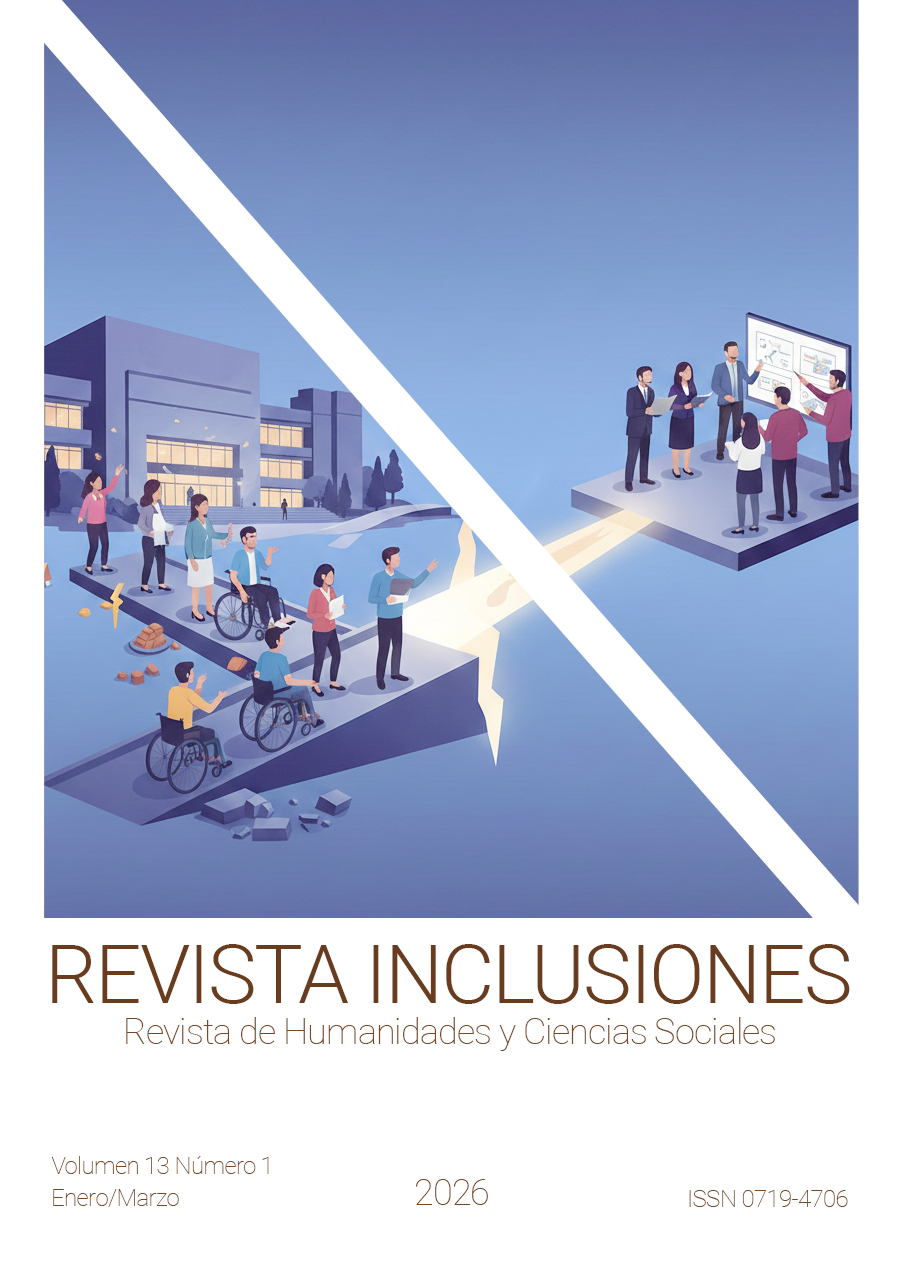
Educational inclusion in higher education constitutes an essential challenge to ensure equity and social justice. The objective of this study was to analyze the perceptions of students and faculty regarding inclusion at Veracruzana University, with an emphasis on identifying barriers and facilitators. A quantitative approach was carried out, with a cross-sectional and descriptive design. Data were collected and processed using descriptive and inferential statistics, including correlational analysis and variance tests. Some results reveal: a gap between teachers' perception and students' experience; barriers linked to infrastructure, limited resources, lack of Mexican Sign Language (MSL) interpreters, and insufficient faculty training in inclusive strategies. Although there is institutional willingness and faculty commitment to improve their competencies in inclusion. The finding of the perception-experience discrepancy constitutes a substantive contribution for rethinking inclusive practices in Mexican and Latin American universities.
References
Ainscow, Mel. 2020. “Promoting Inclusion and Equity in Education: Lessons from International Experiences.” Nordic Journal of Studies in Educational Policy 6 (1): 7–16. https://doi.org/10.1080/20020317.2020.1729587.
Al-Azawei, Ahmed, Francesca Serenelli, y Kjell Lundqvist. 2017. “Universal Design for Learning (UDL): A Content Analysis of Peer-Reviewed Journal Papers from 2012 to 2015.” Journal of the Scholarship of Teaching and Learning 17 (3): 23–56. https://files.eric.ed.gov/fulltext/EJ1104867.pdf.
American Educational Research Association (AERA). 2011. “Code of Ethics.” Educational Researcher 40 (3): 145–156. https://doi.org/10.3102/0013189X11410403.
Angenscheidt Bidegain, Leticia, y Ignacio Navarrete Antola. 2017. “Actitudes de los docentes acerca de la educación inclusiva.” Ciencias Psicológicas 11 (2): 233–243. https://doi.org/10.22235/cp.v11i2.1500.
Babbie, Earl. 2020. The Practice of Social Research. 15ª ed. Cengage Learning.
Burgstahler, Sheryl. 2015. Universal Design in Higher Education: From Principles to Practice. Harvard Education Press.
CAST. 2018. Universal Design for Learning Guidelines Version 2.2. http://udlguidelines.cast.org.
Crenshaw, Kimberlé. 1991. “Mapping the Margins: Intersectionality, Identity Politics, and Violence Against Women of Color.” Stanford Law Review 43 (6): 1241–1299. https://doi.org/10.2307/1229039.
Field, Andy. 2018. Discovering Statistics Using IBM SPSS Statistics. 5ª ed. Sage Edge.
Florian, Lani, y Kristine Black-Hawkins. 2011. “Exploring Inclusive Pedagogy.” British Educational Research Journal 37 (5): 813–828. https://doi.org/10.1080/01411926.2010.501096.
Hernández-Sampieri, Roberto, y Carlos Mendoza. 2018. Metodología de la investigación: Las rutas cuantitativa, cualitativa y mixta. McGraw-Hill.
Lynn, Mary R. 1986. “Determination and Quantification of Content Validity.” Nursing Research 35 (6): 382–385. https://doi.org/10.1097/00006199-198611000-00017.
México. 2011. Ley General para la Inclusión de las Personas con Discapacidad. Diario Oficial de la Federación. http://www.diputados.gob.mx/LeyesBiblio/pdf/LGIPD.pdf.
Meyer, Anne, David H. Rose, y David Gordon. 2014. Universal Design for Learning: Theory and Practice. CAST Professional Publishing.
Moriña, Anabel. 2019. Inclusive Education in Higher Education: Challenges and Opportunities. Springer. https://idus.us.es/server/api/core/bitstreams/4ff5cedb-179d-4d1f-8089-232b0a80f633/content.
Morley, Louise, y Rosalind Lugg. 2009. “Mapping Meritocracy: Intersecting Gender, Poverty and Higher Educational Opportunity Structures.” Higher Education Policy 22 (1): 37–60. https://www.gov.uk/research-for-development-outputs/mapping-meritocracy-intersecting-gender-poverty-and-higher-educational-opportunity-structures-180120.
Nunnally, Jum C., y Ira H. Bernstein. 1994. Psychometric Theory. 3ª ed. McGraw-Hill.
Oliver, Michael. 1990. The Politics of Disablement. Macmillan.
Organization for Economic Cooperation and Development (OECD). 2019. Benchmarking Higher Education System Performance. OECD. https://doi.org/10.1787/be5514d7-en.
Ramírez-Narváez, José R. de J., Ravelo Méndez, y L. Z. Ariza Pérez. 2022. “Educación superior inclusiva: debates y tendencias contemporáneas en América Latina.” EDUSER: Revista Científica Digital de Educación 9 (2): 69–84. https://doi.org/10.18050/eduser.v9n2a7.
Santos, Mariana, y Rodrigo Gaeta. 2020. “Políticas de inclusión en educación superior en América Latina: Un análisis comparado.” Revista Iberoamericana de Educación Superior 11 (31): 3–22.
Seale, Jane. 2014. E-Learning and Disability in Higher Education: Accessibility Research and Practice. Routledge.
Sen, Amartya. 1999. Development as Freedom. Oxford University Press.
Shakespeare, Tom. 2018. Disability: The Basics. Routledge.
Terzi, Lorella. 2014. “Reframing Inclusive Education: Educational Equality as Capability Equality.” Cambridge Journal of Education 44 (4): 479–493. https://doi.org/10.1080/0305764X.2014.960911.
UNESCO. 2020. Global Education Monitoring Report 2020: Inclusion and Education: All Means All. UNESCO Publishing.
United Nations. 2015. Transforming Our World: The 2030 Agenda for Sustainable Development. https://sdgs.un.org/2030agenda.
Wong, Karime V., y Catalina Ortiz Macías. 2024. “Necesidades de inclusión en educación superior en México, desde la voz del alumnado con discapacidad visual.” Eirene. Revista de Paz y Conflictos 7 (12): artículo 243. https://doi.org/10.62155/eirene.v7i12.243
Published
How to Cite
Issue
Section
License
Copyright (c) 2026 Alma Delia Otero Escobar, Mayra Minerva Méndez Anota, Elsa Suárez Jasso

This work is licensed under a Creative Commons Attribution 4.0 International License.
Authors retain copyright and grant Revista Inclusiones the right of publication under Creative Commons Attribution 4.0 International (CC BY 4.0). This allows use, distribution, and reproduction in any medium, provided proper attribution is given to the author.