

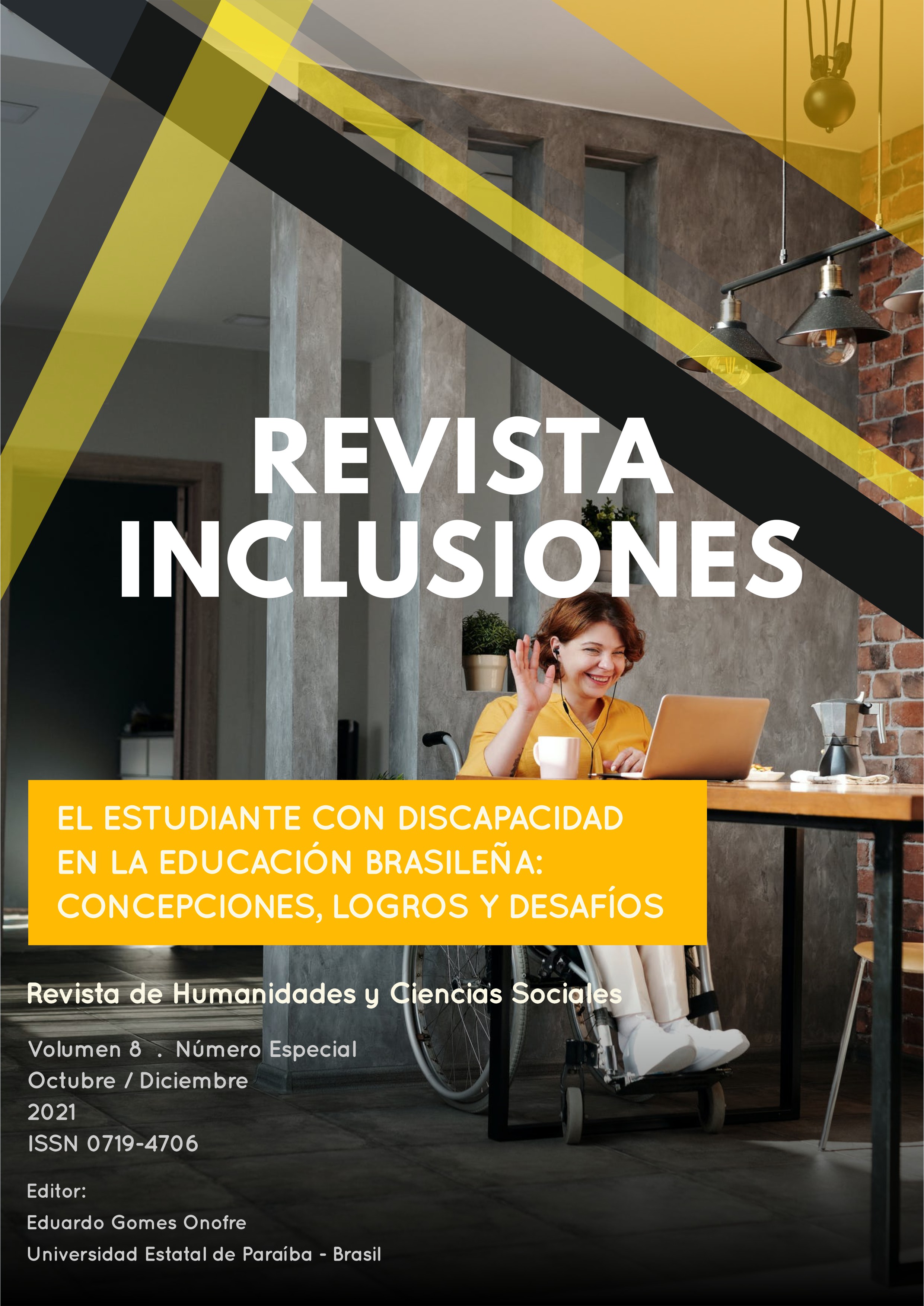
ASSISTIVE TECHNOLOGIES AS NA INTERFACE FOR TEACHING AND LEARNING FOR CHILDREN WITH DISABILITIES
Abstract
The aim of this article is to verify how assistive technologies help in the teaching and learning process
of children with disabilities and how they collaborate in the educational inclusion process of these
subjects. For this, we carried out a case study of a qualitative approach with an exploratory nature,
collecting data through observations and interviews carried out in the Multifunctional Resources
Room of a school located in the city of Campina Grande-PB. For a better understanding, we have
structured the work in three chapters, in the first, we emphasize the challenge of inclusion from the
social to educational context, the second chapter discusses assistive technology (AT) and its
categories, ending with the results of the observations carried out in the research lócus. We conclude
that assistive technologies are fundamental in the teaching and learning process of children with
disabilities, enabling their development in cognitive, social and affective aspects, in addition to
enabling their inclusion by participating in school activities in an autonomous and independent
manner.
Downloads
Downloads
Published
Issue
Section
License
Copyright (c) 2021 Dra. Maria Lúcia Serafim, Lic. Luisa Regina da Silva Pontes

This work is licensed under a Creative Commons Attribution-NonCommercial 4.0 International License.
The authors retain copyright and grant Revista Inclusiones the right to publish under Creative Commons Attribution 4.0 International (CC BY 4.0). Under this license, any user may copy, distribute, and reproduce the content in any medium or format, provided that proper credit is given to the author and the journal as the original source.