REVISTA INCLUSIONES – REVISTA DE HUMANIDADES Y CIENCIAS SOCIALES

ISSN 0719-4706
Volumen 13 Número 2
Abril - Junio 2026
e3834
https://doi.org/10.58210/rie3834
Corals like Stones? Teaching Cnidarians, Coloniality of Knowledge, and Biology Textbooks in Brazil - Volumen 13 Número 2 - Página —-
| |
ISSN 0719-4706 | |
Corals like Stones? Teaching Cnidarians, Coloniality of Knowledge, and Biology Textbooks in Brazil
/
Corais como pedras? Ensino de cnidários, colonialidade do saber e livros didáticos de biologia no Brasil
/
¿Corales como piedras? Enseñanza de cnidarios, colonialidad del saber y libros de texto de biología en Brasil
Dr. Rafael Santos de Aquino
Instituto Federal do Sertão Pernambucano, Brasil
faelaquino@gmail.com
https://orcid.org/0000-0002-8976-2540
Dr. Ricardo Francelino
Universidade de São Paulo, Brasil
rikardofs@usp.br
https://orcid.org/0000-0002-8976-2540
Dr. Lucas Guilherme Tetzlaff de Gerone
Universidade Estadual Paulista, Brasil
lucas.gerone@unesp.br
https://orcid.org/0000-0003-1433-1743
Evelyn Camila Barros Belo
Faculdade de Ciências Humanas do Sertão Central, Brasil
camillabarrosam@gmail.com
https://orcid.org/0009-0002-4169-7265
Victória Fagundes da Silva
Instituto Federal do Sertão Pernambucano, Brasil
victoriafagundes77@gmail.com
https://orcid.org/0009-0006-9371-2606
Me. Bruno Barros
Secretaria Estadual de Educação de Pernambuco, Brasil
rofessorbrunobarros@gmail.com
https://orcid.org/0009-0002-9549-8501
Dr. Alonso Bezerra de Carvalho
Universidade Estadual Paulista Júlio de Mesquita Filho, Brasil
alonso.carvalho@unesp.br
https://orcid.org/0000-0001-5106-2517
Fecha de Recepción: 24 de marzo de 2026
Fecha de Aceptación: 28 de abril de 2026
Fecha de Publicación: 13 de mayo de 2026
Financiamiento:
El autor declara que este estudio no recibió financiación externa.
Conflictos de interés:
El autor también declara no tener ningún conflicto de intereses.
Correspondencia:
Nombres y Apellidos: Dr. Lucas Guilherme Tetzlaff de Gerone
Correo electrónico: lucas.gerone@unesp.br
Dirección postal: Centro - Praça da República, 295 - República, São Paulo - SP, 01045-001, Brasil
Los autores retienen los derechos de autor de este artículo. Revista Inclusiones publica esta obra bajo una licencia Creative Commons Atribución 4.0 Internacional (CC BY 4.0), que permite su uso, distribución y reproducción en cualquier medio, siempre que se cite apropiadamente a los autores originales.
https://creativecommons.org/licenses/by/4.0/
ABSTRACT
This article analyzes the treatment of the phylum Cnidaria in Brazilian high school biology textbooks, discussing the findings considering the environmental history of the Brazilian northeastern coast and the coloniality of knowledge in the production of school knowledge. This qualitative documentary research is based on a corpus composed of six textbooks approved by the National Textbook Program (Programa Nacional do Livro Didático – PNLD, in Portuguese), which were analyzed according to criteria related to theoretical content, historical contextualization, and the valorization of Brazilian biodiversity. The results indicate the predominance of descriptive and fragmented approaches, with a strong emphasis on foreign examples, especially Australia’s Great Barrier Reef, to the detriment of Brazilian reefs. Furthermore, there is an absence of discussion regarding the biomineral exploitation of corals during the colonial period. In light of the complexity paradigm and decoloniality, it is argued that such omission contributes to the erasure of the biological, historical, and environmental dimensions of corals in the teaching of Biology.
Keywords: Brazilian marine biodiversity; Coloniality of knowledge; Critical science education; Environmental history; Complexity paradigm
RESUMO
Este artigo analisa o tratamento do filo Cnidaria em livros didáticos de Biologia do Ensino Médio, discutindo os resultados à luz da história ambiental da costa nordestina brasileira e da colonialidade do saber na produção do conhecimento escolar. Trata-se de uma pesquisa qualitativa e documental, cujo corpus é composto por seis livros didáticos aprovados pelo Programa Nacional do Livro Didático (PNLD), analisados segundo critérios relacionados ao conteúdo teórico, à contextualização histórica e à valorização da biodiversidade brasileira. Os resultados indicam a predominância de abordagens descritivas e fragmentadas, com forte valorização de exemplos estrangeiros, especialmente a Grande Barreira de Corais da Austrália, em detrimento dos recifes brasileiros. Observa-se ainda a ausência de discussões sobre a exploração biomineral dos corais no período colonial. À luz do paradigma da complexidade e da decolonialidade, argumenta-se que essa omissão contribui para o apagamento da dimensão biológica, histórica e ambiental dos corais no ensino de Biologia.
Palavras-chave: Biodiversidade marinha brasileira; Colonialidade do saber; Educação científica crítica; História ambiental; Paradigma da complexidade
RESUMEN
Este artículo analiza el tratamiento del filo Cnidaria en libros de texto de Biología para la Educación Secundaria, discutiendo los resultados a la luz de la historia ambiental de la costa noreste brasileña y de la colonialidad del saber en la producción del conocimiento escolar. Se trata de una investigación cualitativa y documental, cuyo corpus está compuesto por seis libros de texto aprobados por el Programa Nacional del Libro Didáctico (PNLD), analizados según criterios relacionados con el contenido teórico, la contextualización histórica y la valorización de la biodiversidad brasileña. Los resultados indican la predominancia de enfoques descriptivos y fragmentados, con fuerte énfasis en ejemplos extranjeros, especialmente la Gran Barrera de Coral de Australia, en detrimento de los arrecifes brasileños. Se observa también la ausencia de discusiones sobre la explotación biomineral de los corales en el período colonial. A la luz del paradigma de la complejidad y la decolonialidad, se argumenta que esta omisión contribuye al borramiento de las dimensiones biológica, histórica y ambiental de los corales en la enseñanza de la Biología.
Palabras clave: Biodiversidad marina brasileña; Colonialidad del saber; Educación científica crítica; Historia ambiental; Paradigma de la complejidad
INTRODUCTION
The teaching of Biology in Brazilian high schools has historically been marked by a fragmented approach to content, frequently dissociated from the social, historical, and environmental contexts in which scientific knowledge is produced and applied [1]. Regarding the study of cnidarians, this fragmentation is manifested in the excessive emphasis on morphological and taxonomic descriptions, to the detriment of discussions that connect the biology of these organisms to the dynamics of reef ecosystems, the history of coastal occupation, and the cumulative anthropogenic impacts over time. This fragmentation can also be understood in light of the disciplinary organization of scientific knowledge, wherein scientific communities operate within paradigms that guide shared problems, methods, and explanatory models [2].
Cnidarians, especially scleractinian corals, constitute the structural basis of coral reefs, ecosystems recognized for their high biodiversity and essential ecosystem services such as coastal protection, support of trophic chains, and underpinning economic activities [3]. Despite this ecological and socio-economic relevance, coral reefs continue to appear in a limited or superficial manner in many didactic approaches to marine biodiversity within the materials used for Biology education. In Brazil, these ecosystems possess unique characteristics, with a high rate of endemism and broad distribution along the northeastern coastline. Nevertheless, Biology textbooks recurrently emphasize foreign examples. This pattern contributes to the construction of a distanced perception of Brazilian biodiversity, in which local ecosystems appear as secondary or merely illustrative. In particular, the Australian Great Barrier Reef is prioritized—at the expense of valuing Brazilian reef systems, such as those located between the southern coast of Pernambuco and the northern coast of Alagoas, within the Corals Coast Environmental Protection Area (EPA).
This didactic choice is not neutral [4]. The prioritization of external referents reflects a logic of the coloniality of knowledge, wherein knowledge produced in hegemonic contexts is considered universal, while local scientific, environmental, and historical experiences remain marginalized. In the Brazilian case, such marginalization is exacerbated when considering that the coral reefs of the Northeast were intensely exploited as a biomineral resource during the colonial period, being used in the construction of churches, residences, fortifications, and in the opening and consolidation of ports. These processes, although fundamental to the formation of coastal cities, remain scarcely discussed both in scientific literature and educational materials, contributing to the erasure of a relevant dimension of the country's environmental history. The absence of this historical dimension in didactic materials contributes to a decontextualized understanding of marine biodiversity, in which organisms are predominantly presented as objects of biological classification.
Understanding the teaching of cnidarians from this perspective requires overcoming linear and reductionist readings typical of a Cartesian paradigm that separates nature and society, science and history, biology and culture [5]. Therefore, the analysis of textbooks demands an approach that recognizes the complexity of socio-environmental phenomena, considering the interrelations among ecological, historical, geographical, and epistemological processes. Such a stance allows for the understanding that the lack of contextualization in didactic materials is not merely a pedagogical failure, but expresses broader relations among scientific production, environmental memory, and colonial legacies.
In this sense, this article aims to analyze the content referring to the phylum Cnidaria in Biology textbooks used in Brazilian high schools, discussing the results in light of the historical facts related to the biomineral exploitation of coral reefs in northeastern Brazil and the limited scientific interest dedicated to these processes and their impacts on marine biodiversity [6].
1. PHYLUM CNIDARIA: SCIENTIFIC CONTENT REDUCED TO A BIOLOGICAL APPROACH
The phylum Cnidaria comprises diverse organisms, including anemones, jellyfish, hydras, corals, hydroids, gorgonians, siphonophores, zoanthids, and myxozoans, totaling approximately 11,000 described species. This diversity is primarily related to colony formation via asexual reproduction and a dimorphic life cycle characterized by polypoid and medusoid forms. The name of the phylum derives from the presence of stinging cells—cnidocytes or cnidoblasts—used for prey capture and defense [7].
Cnidarians are diploblastic metazoans with radial symmetry, possessing an incomplete gastrovascular cavity, mesoglea, and lacking cephalization, a central nervous system, and specialized organs for respiration, circulation, and excretion. Their ancestral Bauplan, marked by radial symmetry and a nerve net, diffuse nervous system is associated with sessile, sedentary, or pelagic lifestyles, allowing for food capture in multiple directions [8]. Despite these limitations, the group’s evolutionary success is related to the alternation between polyp and medusa stages, enabling the exploitation of distinct environments and resources [9].
Many cnidarians exhibit colonial growth, especially corals, hydroids, and siphonophores, with varied structural forms such as stolonal, coenosarcial, and arborescent [10]. Among the occupied environments, reef ecosystems stand out, where scleractinian corals act as ecological engineers, sustaining high biodiversity and forming consolidated substrates [11]. Brazilian reefs display lower diversity of scleractinian corals compared to the Caribbean and Indo-Pacific regions [12], generally occurring in clear, shallow waters due to the light dependency of their symbiotic zooxanthellae [13].
These ecosystems rank among the most important marine environments, providing food, habitat, coastal protection, and economic support through tourism [14]. Along the coast of Pernambuco, 15 coral species have been recorded, with emphasis on Siderastrea stellata, a Brazilian endemic species that forms spherical or flat colonies and occurs in well-lit areas and tide pools [15].
2. BIOLOGY EDUCATION, TEXTBOOKS, AND THE CONTEXTUALIZATION OF SCIENTIFIC KNOWLEDGE
Textbooks occupy a central position in Brazilian secondary education, especially in public schools, where they often constitute the primary pedagogical resource. In Biology education, these materials influence the selection, organization, and interpretation of scientific content, guiding ways of knowledge appropriation by students [16]. This process of selection and organization of scientific content reflects knowledge production within a pedagogical structure that frequently neglects the inclusion of peripheral knowledges, such as local ecological knowledge and Brazil’s environmental history.
Despite advances resulting from policies such as the PNLD (National Textbook Program), studies indicate persistent limitations in the contextualization of scientific knowledge. These are manifested in content fragmentation, predominance of descriptive approaches, and weak articulation with historical and socio-environmental contexts [17]. This reflects an epistemological logic separating nature, society, and history. Contextualization is recognized as an essential principle for meaningful learning, as it enables the relation of scientific concepts to students’ social and environmental realities; however, analyses indicate a predominance of content-based and encyclopedic perspectives [18].
This dynamic reinforces the perception of science as neutral and ahistorical and contributes to the marginalization of themes such as Brazilian biodiversity and environmental history [19]. In marine biology education, there is also a prioritization of foreign examples, hindering the valorization of national contexts [20]. Thus, textbooks must be understood as cultural products that reflect pedagogical and epistemological conceptions, making their critical analysis fundamental for the construction of more contextualized and socially situated approaches.
3. BEYOND THE CARTESIAN PARADIGM: COMPLEXITY AND DECOLONIALITY AS FOUNDATIONS FOR CRITICAL BIOLOGICAL EDUCATION
The analysis of Biology textbooks requires an understanding of the scientific and philosophical paradigms that guide the production and organization of school knowledge. Therefore, the textbook is not a neutral instrument, but rather the materialization of epistemological conceptions embedded in the formation of its authors and expressed in the selection and representation of content. According to Aquino (2022) [21], the paradigm must be understood as a philosophical framework and pedagogical practice that materializes in didactic devices.
The hegemony of the Cartesian paradigm, characterized by disciplinary fragmentation and explanatory reductionism, directly influences the structure of textbooks, which are often organized into descriptive and classificatory blocks that limit the contextualization of biological phenomena. Studies show that such materials prioritize taxonomic and morphofunctional approaches with low interdisciplinary articulation [22]. In the imagery domain, the predominance of illustrative and poorly contextualized images reinforces the fragmentation of knowledge and diminishes the understanding of biodiversity as a complex system [23].
The complexity paradigm proposed by Edgar Morin (2015) [24], allows the problematization of this fragmentation by emphasizing the contextualization and multidimensionality of knowledge. In this sense, the coloniality of knowledge manifests itself in the organization and selection of didactic content. This highlights the reproduction of epistemological hierarchies privileging Eurocentric references and marginalizing local contexts [25]. [26] highlights that education constitutes a space of epistemological contention, with didactic materials being central elements in this process.
The articulation between complexity and decoloniality enables the understanding of the textbook as an epistemological artifact that materializes scientific and philosophical paradigms. Thus, the reductionism in the approach to cnidarians and the absence of contextualization of Brazilian reefs reflect the influence of the Cartesian paradigm, indicating the need for complex and decolonial perspectives for the critical analysis and the problematization of epistemological gaps present in the representation of marine biodiversity.
4. BIOMINERAL EXPLOITATION OF REEFS AND ENVIRONMENTAL HISTORY OF THE NORTHEASTERN COAST
The colonial occupation of the Brazilian northeastern coast was strongly associated with the exploitation of reef environments as a source of biomineral material. Since the 16th century, corals and sandstones have been extensively used in the construction of churches, houses, fortifications, and port works, reflecting a colonial extractivist logic that conceived reefs as geological resources available for territorial occupation [27]. Environmental history studies indicate that these ecosystems played a decisive role in the consolidation of colonial cities and experienced interventions related to the establishment and expansion of ports, including the removal of reef blocks and alterations in coastal morphology [28].
Although fundamental for colonial economic development, the ecological impacts of these practices have historically been little discussed. The removal of reef material compromised essential ecological processes such as biodiversity maintenance, coastal protection, and hydrosedimentary dynamics, resulting in cumulative long-term effects [29]. This silence contributes to the naturalization of reef degradation and to fragmented approaches to marine biodiversity loss [30].
In Biology education, the absence of this historical dimension limits the understanding of reefs as complex socioenvironmental systems, reinforcing exclusively biological and decontextualized approaches. Thus, the incorporation of the environmental history of biomineral exploitation into the teaching of cnidarians is essential to fostering a critical and contextualized approach to Brazilian marine biodiversity.
5. CORAL REEFS IN BRAZIL: BIODIVERSITY, UNIQUENESS, AND DIDACTIC INVISIBILITY
Brazilian coral reefs constitute one of the most extensive and unique reef systems of the South Atlantic, distributed mainly along the Northeastern coastal reef, presenting high biodiversity, endemism, and adaptations to environmental conditions such as turbidity and fluvial influence [31]. Unlike classical tropical reefs, many of these environments develop over reef sandstones under conditions considered suboptimal, conferring high ecological complexity and relevance for studies on the resilience and evolution of cnidarians [32].
Recent research has expanded this understanding by identifying extensive deep reef systems at the mouth of the Amazon River, highlighting Brazil’s role as a custodian of reef heritage of global importance [33]. Nevertheless, analyses indicate that Brazilian reefs remain invisibilized in textbooks, frequently replaced by foreign examples such as the Australian Great Barrier Reef [34].
This invisibilization limits the recognition of national marine biodiversity and hampers the approach to historical and socio-environmental issues associated with coastal exploitation [35]. In Biology education, the valorization of external examples reinforces the distancing between school knowledge and the students’ environmental reality, making the incorporation of the singularities of Brazilian reefs essential to promote a more integrated understanding of marine ecosystems.
6. MATERIAL AND METHODS
The present research is characterized as a qualitative documentary study, focusing on the critical analysis of Biology textbooks used in Brazilian Secondary Education, grounded in decoloniality and the complexity paradigm. The choice of this methodological approach is based on the understanding that textbooks constitute important mediators of scientific school knowledge, reflecting curricular, epistemological, and pedagogical conceptions that guide the teaching of Science and Biology in the Brazilian educational context.
6.1 SELECTION OF DIDACTIC MATERIAL
The analyzed material comprised six Biology textbooks intended for Secondary Education, widely used in Brazilian public schools and approved in different editions of the National Textbook Program (PNLD). The selection of the works was based on three main criteria: (i) wide circulation in the school context; (ii) adoption by public education networks; and (iii) explicit presence of content related to the phylum Cnidaria in their chapters or thematic sections.
Including books from different collections and publishers enabled a broader comparative analysis of the approaches adopted for teaching cnidarians, reducing biases associated with specific editorial styles and allowing the identification of recurring patterns in contemporary didactic materials.
For purposes of organization and systematization of the analysis, the textbooks comprising the research corpus were identified by alphanumeric codes, a procedure widely used in documentary studies in the field of Science Education. Thus, the following correspondence was adopted: TB1 – Biology in Context: the Diversity of Living Beings [36]; TB2 – Biology: Living Beings [37]; TB3 – New Foundations of Biology: Living Beings and Communities [38]; TB4 – Biology Today [39]; TB5 – Bio [40]; TB6 – Biology [41]. This coding was employed throughout the presentation and discussion of the results to facilitate reading and avoid excessive repetition of the titles.
6.2 ANALYSIS PROCEDURE
The analysis of the textbooks was conducted based on an adaptation of the criteria proposed by Vasconcelos and Souto (2003) [42], widely used in research investigating the quality of zoological content in didactic materials. These criteria were organized into four main analytical axes:
Each work was analyzed systematically, with qualitative concepts assigned to each of the criteria, according to the original methodology proposed by the authors, with specific adaptations to meet the specific objectives of this study.
The application of the four analytical axes was carried out systematically in each of the works that made up the research corpus (L1–L6). Initially, a complete reading of the chapters and sections dedicated to the phylum Cnidaria in each textbook was carried out, identifying the units of analysis corresponding to textual excerpts, visual resources, proposed activities, and complementary elements.
Next, these units were examined considering the criteria defined for each analytical axis. In the theoretical content axis, aspects such as conceptual correctness, level of depth, and presence of ecological and historical contextualization were analyzed; in the visual resources axis, the relevance, didactic function, and contextualization potential of the images were evaluated; in the activities axis, the degree of problematization, contextualization, and stimulation of reflection was investigated; and, in the additional resources axis, the presence of interdisciplinary elements and connections with socio-environmental themes was verified.
For each criterion, qualitative concepts were assigned based on the recurrence and consistency of the evidence identified in each work, allowing the construction of a comparative overview between the materials analyzed.
In addition, the analytical criteria were revisited throughout the analysis process, with a reassessment of borderline cases and verification of coherence in the assignment of qualitative concepts. This procedure is sought to reduce interpretive biases and ensure greater consistency in the application of the analytical axes. The results of this systematization are organized in Table 1.
In addition to this described methodology, an analysis of the content of the books was also considered considering scientific paradigms (Cartesian and complex), decoloniality, compliance with Law No. 10,639/2003, and the biological and contextual invisibility of the cnidarian theme.
6.3 DATA ORGANIZATION AND INTERPRETATION
The data obtained through the application of the analytical criteria were organized into comparative tables, allowing visualization of convergences and divergences among the evaluated textbooks. This organization enabled the identification of approach patterns, thematic recurrences, and gaps in the treatment of content regarding the phylum Cnidaria.
The interpretation of results was conducted in a qualitative and critical manner based on Vasconcelos and Souto (2003) [43], decoloniality according to Quijano (2005) [44], and the complexity paradigm according to Morin (2015) [45], seeking to go beyond mere data description. In this process, the findings of the documental analysis were discussed considering theoretical frameworks from the field of Biology Education, as well as contributions from environmental history and epistemological critique. Particular attention was given to the historical processes of biomineral exploitation of coral reefs in the Northeast region of Brazil and their implications for marine biodiversity.
This analytical perspective allowed for an understanding of textbooks not only as pedagogical instruments but also as cultural and historical products in which silences, hierarchizations of knowledge, and colonial legacies permeate Science education in Brazil.
7 RESULTS AND DISCUSSION
The analysis of High School Biology textbooks revealed a recurring pattern of superficial and decontextualized treatment confirming results previously reported by various studies on Zoology education in Brazil. Such an approach reflects a epistemological model where cnidarians are predominantly presented from a classificatory and morphophysiological perspective, with emphasis on general characteristics, life cycles, and body organization, yet with limited problematization of their ecological, historical, social, and environmental relevance within the Brazilian context. This underscores the coloniality of knowledge present in the educational materials.
7.1 CHARACTERIZATION OF THE ANALYZED CORPUS
Table 1 presents the analyzed textbooks, indicating authors, year of publication, publisher, and PNLD edition, as well as the location of content related to cnidarians in each work. The analysis revealed that, in all textbooks, the phylum Cnidaria appears concentrated in chapters dedicated to Invertebrate Zoology, generally associated with a sequential and linear approach to animal diversity. This reflects a disconnection between biology and socio-environmental realities, hindering the comprehension about the phylum Cnidaria within a broader ecological and historical context.
Table 1 – Characterization of the analyzed textbooks and synthesis of the results
Book | PNLD | Conceptual Approach | Brazilian Corals | Contextualization | Biomineral Exploitation | Images - Photo | Images - Diagram | |
Historical | Biological | |||||||
LD1 | 2018 | Descriptive | Absent | Absent | Reduced to species | Absent | Present | Present |
LD2 | 2018 | Descriptive | Superficial | Absent | Reduced to species | Absent | Present | Present |
LD3 | 2020 | Descriptive | Absent | Absent | Reduced to species | Absent | Present | Present |
LD4 | 2020 | Descriptive | Superficial | Absent | Reduced to species | Absent | Present | Present |
LD5 | 2021 | Descriptive | Superficial | Absent | Reduced to species | Absent | Present | Present |
LD6 | 2021 | Descriptive | Absent | Absent | Reduced to species | Absent | Present | Present |
Source: authorship.
The Table 1 shows that the six textbooks (TB1–TB6), predominantly present a descriptive conceptual approach to the phylum Cnidaria. References to Brazilian corals are limited, occurring superficially in TB2, TB4, and TB5, and are absent in TB1, TB3, and TB6. Regarding contextualization, the historical dimension is absent in all works, whereas biological contextualization is recurrently restricted to the description of isolated species, without articulation with broader ecological or biogeographical aspects. Biomineral exploitation of coral reefs is also not addressed in any of the textbooks analyzed. Fact that denotes the invisibilization of Brazilian biodiversity and local environmental history, as the biomineral exploitation of coral reefs and its implications for marine biodiversity are not discussed.
Concerning visual resources, all materials present photographs and diagrams. The diagrams focus on explaining biological processes, especially reproduction, life forms, embryonic development, and tissue organization of cnidarians. The photographs aim to illustrate species and their natural forms, with the brain coral (Mussismilia braziliensis) recurrently featured in textbooks TB1 and TB4. Despite this visual presence, there is a lack of contextualization regarding the occurrence of these organisms along the Brazilian coast, as well as their historical and environmental value for national marine biodiversity. The possibility of constructing interdisciplinary content articulated with History and Geography, for example, and stimulating the development of interdisciplinary and holistic thinking is lost.
The interpretation of the results was guided by the complexity paradigm, which understands scientific knowledge as a web of dynamic relationships among biological, historical, geographical, social, and cultural dimensions. By adopting this perspective, we sought to understand not only the theoretical content but also the interconnection among the knowledge bases underpinning scientific education. From this standpoint, the analysis of textbooks is not limited to the isolated verification of conceptual contents, visual resources, or proposed activities; rather, it seeks to comprehend the interdependencies among these dimensions and their effects on the construction of school knowledge about cnidarians. By adopting complexity as an analytical framework, the study highlights that teaching about cnidarians cannot be dissociated from aspects such as environmental history, biomineral exploitation, social perception, and marine conservation, reinforcing the need for didactic approaches that articulate multiple scales and dimensions of the investigated phenomenon.
7.2 ANALYSIS OF SPECIFIC CONTENT: PHYLUM CNIDARIA
The analysis of the theoretical content regarding the phylum Cnidaria in the investigated textbooks revealed relatively homogeneous patterns concerning the classical structural criteria proposed by Vasconcelos and Souto (2003) [46], although relevant variations emerged when epistemological and critical aspects were considered. This reflects a Eurocentric view of scientific knowledge, highlighting the absence of a critical approach and contextualization of cnidarians within the Brazilian ecological and historical reality.
Regarding the criterion of suitability for the educational level, all the analyzed textbooks—TB1, TB2, TB3, TB4, TB5, and TB6—were classified as excellent, indicating alignment among language, conceptual complexity, and the high school education level. This result suggests that the content is formally adjusted to curricular guidelines, although such adequacy does not necessarily imply critical depth or socio-scientific contextualization. The mere correspondence between language and educational level is insufficient to provide a contextualized and decolonial education, which includes discussions on local biodiversity and Brazilian environmental history.
Concerning text clarity, textbooks TB1, TB2, TB3, TB4, and TB6 demonstrated excellent performance, with objective definitions and appropriate use of scientific terminology. Textbook TB5 was rated as good, indicating lower conceptual precision or less explanatory detail. This finding resonates with previous analyses that identify significant variations in the conceptual quality of zoological content in textbooks, especially in older publications [47].
Regarding the level of text updating, greater heterogeneity was observed. Textbooks TB2, TB3, TB4, and TB6 were evaluated as excellent, whereas TB1 and TB5 received a good rating, suggesting partial obsolescence concerning recent advances in marine biology and contemporary scientific production on coral reefs. This result is consistent with studies pointing to the persistence of outdated zoological content, particularly with respect to Brazilian biodiversity [48].
For the criterion of coherence among the presented information, textbooks TB2, TB3, TB4, TB5, and TB6 were rated as excellent, while TB1 obtained a good evaluation, indicating minor limitations in the internal articulation of content. Similarly, the inter-chapter articulation was considered excellent in all analyzed works (TB1 to TB6), evidence of consistent didactic organization.
However, these positive results do not extend to the criterion regarding the stimulation of student critical thinking. Textbooks TB1 and TB4 were classified as regular, T6 as good, whereas TB2, TB3, and TB5 achieved excellent evaluations. These data reveal that, even in well-structured works, the teaching of cnidarians remains predominantly descriptive, with little historical, environmental, or socio-scientific problematization—an aspect widely criticized in the literature on Zoology teaching in Brazil [49].
With respect to conceptual completeness, significant gaps were identified. Textbooks TB1 and TB4 presented content classified as incomplete, especially regarding the zoological classification of the phylum Cnidaria and the explicit delineation of its classes. Although these works mention examples of diversity, the absence of a systematic approach compromises the understanding of the group’s biological complexity, as also noted by Neves et al. (2016) [50].
It was further observed that textbooks TB2, TB3, TB5, and TB6 include supplementary texts, while TB1 and TB4 do not. However, even when present, such texts rarely establish connections with the Brazilian reality, reinforcing the centrality of foreign examples, particularly the Great Barrier Reef of Australia. This tendency contributes to the invisibilization of Brazilian reefs and reflects the coloniality of knowledge in Biology education [51].
Finally, it appears that none of the analyzed textbooks (TB1–TB6) address the biomineral exploitation of coral reefs during the colonial period, a central element in the environmental history of the northeastern coast. This absence reinforces a widely disseminated social perception that corals are inert structures rather than living organisms, as documented by the [52] and discussed by Coral Vivo Project (2022) [53].
This pattern converges with findings by Vasconcelos and Souto (2003) [54], who identified the predominance of content-centered approaches in Zoology education, focusing on memorization of diagnostic characteristics of animal groups. More recent studies reinforce this trend, indicating that PNLD textbooks continue to prioritize an informative approach at the expense of historical, ecological, and social contextualization of the content [55].
In the specific case of cnidarians, it was observed that none of the analyzed textbooks establishes explicit relationships between the biology of these organisms and Brazilian marine biodiversity, nor do they discuss their historical or socio-environmental importance within the context of the northeastern coastline.
7.3 INVISIBILITY OF BRAZILIAN MARINE BIODIVERSITY
One of the main findings concerns the invisibility of Brazilian coral reefs in the textbooks. In the six evaluated works (TB1, TB2, TB3, TB4, TB5 and TB6), the Great Barrier Reef of Australia is used as the central point of reference, while mentions of national reefs are superficial and do not highlight the world’s second largest coral barrier located in the Northeast, nor the reef banks of the Brazilian continental shelf. The socio-economic contributions of these ecosystems—such as tourism associated with the Costa dos Corais Environmental Protection Area—are also not addressed, thereby neglecting their importance for sustainable tourism and artisanal fishing along the northeastern coast. These findings corroborate studies pointing to the marginalization of Brazilian marine biodiversity in textbooks [56].
In TB 2, in the "Reading" section, on page 156, there is information stating that in Brazil coral reefs only occur in the Abrolhos archipelago and in Ilhéus in Bahia and in the Rocas Atoll. This information is untrue and materializes the invisibility of Brazilian corals.
In textbooks TB1, TB2, TB3 and TB4, the red sea anemone (Actinia equina), which occurs throughout the Brazilian coast, is presented in photos, but decontextualized and sometimes without identification of the species, location of the record and occurrence of the species. Book TB1 opens with a photo of corals from Sulawesi Island in Thailand and includes photographs of Brazilian species without species identification or information about their occurrence.
Book TB2 presents photos of jellyfish, Portuguese man-of-war, and sea wasps, but without identifying them or discussing their occurrences. There is also a classic image of symbiotic interaction between an anemone and a clownfish, which do not occur in the Brazilian marine biome; they originate from the Indo-Pacific marine biome.
Book TB3 presents a photo of a coral reef platform from the Great Barrier Reef in Australia. No book depicts Brazilian corals or coral reefs in photos, even though there is a protected area dedicated to the preservation of coral reefs in Brazil.
Another point is that the red anemone is represented in most of the books, but only in one of them (TB1) is it zoologically identified and identified as a typical Brazilian species. In addition, the biodiverse context of Brazilian cnidarian species available in textbooks is reduced to the red anemone, and this reduction leads to the invisibility of cnidarians.
This didactic choice reinforces the foreignization of scientific knowledge, evidencing cultural selection processes that hierarchize knowledge and silence local contexts [57]. The invisibilization also manifests in the imagery representation, which tends to privilege organisms with greater cultural familiarity, resulting in the underrepresentation of marine environments [58]. In the case of cnidarians, images are scarce and limited to classificatory approaches, with little ecological or socio-cultural contextualization [59]. Furthermore, visual resources frequently serve an illustrative function without promoting critical contextualization, contributing to the symbolic erasure of Brazilian reefs and to the maintenance of Eurocentric perspectives in the approach to marine biodiversity [60].
7.4 IMAGE ANALYSIS AND PEDAGOGICAL LIMITATIONS
Regarding the use of images, the results obtained in this study align directly with research analyzing the imagetic dimension of cnidarians in textbooks. Bezerra dos Santos et al. (2023) [61] identified that, although there is a considerable number of images associated with the phylum Cnidaria, many of them possess low didactic value, conceptual deviations, or articulation problems with the text, which contradict the principles of the Cognitive Theory of Multimedia Learning [62].
Similarly, Souza et al. (2024) [63] highlight that photographic images of cnidarians in textbooks tend to emphasize biomedical aspects, such as accidents involving bathers, to the detriment of socio-environmental, educational, or preventive approaches. This limitation reduces the potential of images as tools for the construction of meaningful and critical learning, as well as their role in reinforcing negative stereotypes associated with these organisms without being treated as an approach focused on Health Education.
The imagetic analysis of textbooks reveals that images constitute central pedagogical elements in mediating scientific knowledge, performing relevant cognitive and semiotic functions in the construction of meanings by students [64]. However, studies indicate that the pedagogical effectiveness of these resources depends on their integration with the text and the interpretative context provided by the teacher, since the image alone does not guarantee conceptual understanding [65].
In the specific field of cnidarians, research shows that photographic images in textbooks present limitations regarding the diversity of approaches, focusing predominantly on biomedical or classificatory representations, with a lack of socio-environmental and behavioral perspectives [66]. This restriction reduces the formative potential of images and limits the exploration of ecological, historical, and cultural dimensions of the content.
Additionally, investigations into the use of images in Biology textbooks highlight that, although these resources can foster meaningful learning by establishing connections between scientific knowledge and students’ realities, they are often used merely as illustrative elements, without deeper pedagogical exploitation [67]. This condition contributes to the fragmentation of knowledge and hinders the construction of interdisciplinary and contextualized approaches, especially on topics related to marine biodiversity and coral reefs.
It was observed in the textbooks that, generally, the works present good technical quality of images but significant limitations concerning their pedagogical and semiotic potential, according to the criteria proposed by Vasconcelos and Souto (2003) [68].
Regarding the quality of the illustrations—considering aspects such as sharpness, use of colors, and definition—textbooks TB3, TB4, and TB6 were classified as excellent, while TB2 and TB5 received a good evaluation. The TB1 performed poorly and was classified as fair based on this criterion. These data indicate that, although most works provide visually adequate images, there are still significant discrepancies among the materials, especially in works prioritizing simplified schemes or images with limited detail.
With respect to the degree of correlation between images and the information contained in the text, textbooks TB2, TB3, and TB6 were evaluated as excellent, demonstrating satisfactory integration between verbal and visual language. Textbooks TB1, TB4, and TB5 were classified as good, indicating that although the images are related to the content presented, they do not always function as effective mediators of conceptual construction. Studies in educational semiotics point out that merely illustrative images tend to reinforce superficial learning without promoting more complex conceptual articulations [69].
In the criterion of image placement throughout the text, all analyzed textbooks (TB1 to TB6) received an excellent rating, demonstrating good layout and visual distribution of content. This result suggests an editorial concern with graphic organization, although such formal quality alone does not guarantee the critical pedagogical use of images.
The accuracy of the information contained in the illustrations was also evaluated as excellent in all works (TB1–TB6), with no biologically incorrect representations identified. This finding is relevant, as it excludes the possibility of direct induction of conceptual errors, an aspect frequently problematized in imagetic analyses of Biology textbooks [70].
When the possibility of contextualization is analyzed, the results become significantly more critical. Textbooks TB1 and TB3 were classified as weak, while TB4, TB5, and TB6 received a regular rating. Only TB2 obtained a good classification in this criterion. These data reveal that, although the images adequately represent morphological aspects and life cycles of cnidarians, they are rarely used to establish connections with the Brazilian reality.
This limitation is particularly evident in the choice of visual examples. All books, except TB1, mention Brazilian reefs such as Atol das Rocas (RN) and Abrolhos (BA), and L2 explicitly highlights Recife (PE), city that receives its name from the massive presence of coral reefs, and its historical relationship with corals. However, all books except TB1 visually emphasize the Great Barrier Reef of Australia, while none of the works address imagetically the second largest coral belt in the world, located in the APA Costa dos Corais, between Pernambuco and Alagoas, as described by Steiner et al. (2015) [71]. This pattern reinforces processes of invisibilization of national biodiversity and aligns with the coloniality of knowledge in science education [72].
Regarding the degree of innovation and creativity, textbooks TB2, TB3, TB4, and TB6 were classified as good, whereas TB1 and TB5 received weak evaluations. In general, a predominance of photographs of species and traditional diagrams was observed, with limited use of visual resources that encourage critical reading, problematization, or multiple interpretations—central elements of the semiotic approach in Biology education [73].
Positively noteworthy is that all analyzed books present a diversity of images, including photographs of different species, morphofunctional diagrams, and explanatory diagrams of the dimorphic life cycle and forms of reproduction of cnidarians. However, this diversity does not translate into contextual or epistemological deepening, remaining restricted to the descriptive dimension.
Finally, it was found that none of the textbooks (TB1–TB6) use visual resources in a way that induces biologically incorrect interpretations, indicating technical care in the preparation of the images. Still, considering educational semiotics, the absence of historical, environmental, and social problematization in visual representations contributes to a fragmented understanding of cnidarians, reinforcing their perception as static or merely decorative elements of marine ecosystems.
The absence of contextualized images representing Brazilian reefs, the northeastern coastal environments, and the historical interaction between society and marine ecosystems contributes to the symbolic erasure of these spaces in educational materials. As argued by Neves et al. (2016) [74], images are not neutral elements but carry intentionalities and worldviews that directly influence teaching and learning processes.
Thus, the results highlight that, although the textbooks present technical quality and scientific accuracy in the images, visual resources are underutilized as instruments of semiotic and critical mediation. Considering the complexity paradigm, this limitation underscores the need to integrate images, text, and historical-environmental context, to promote a broader and situated understanding of cnidarians within the Brazilian reality.
7.5 ANALYSIS OF THE ACTIVITIES PROPOSED IN THE TEXTBOOKS
The analysis of the activities proposed in the textbooks revealed that all present exercises at the end of chapters on Cnidaria, with difficulty levels suitable for high school, indicating alignment with the traditional didactic structure [75]. However, differences emerge regarding the formative potential of the activities. Textbooks TB2, TB3, TB4, TB5, and TB6 present some multidisciplinary focus and problem-posing, albeit limited, whereas TB1 maintains a predominantly content-based approach, corroborating studies that indicate a persistence of assessment practices centered on memorization [76].
A critical finding concerns the absence of contextualization in all the textbooks (TB1–TB6), with rare connections made between the content and socio-environmental, historical, or regional aspects of cnidarians, reinforcing the fragmentation of knowledge [77]. Only TB2 and TB4 propose collaborative activities, feasible practices, and encourage the use of technologies, evidencing low incorporation of investigative and digital methodologies and a detachment from real school conditions [78].
Overall, the activities remain anchored in a traditional pedagogical model, limiting an integrated understanding of cnidarians and omitting discussions on biomineral exploitation and the socio-environmental impacts of Brazilian reefs, which contributes to the reproduction of decontextualized and colonialized perspectives of scientific school knowledge [79].
7.6 ANALYSIS OF ADDITIONAL DIDACTIC RESOURCES
The analysis of additional resources in the textbooks revealed a predominance of tools aimed at teacher support and a scarcity of materials that enhance student autonomy. Glossaries are present in TB2, TB3, TB4, TB5, and TB6, favoring terminological consolidation, whereas their absence in TB1 indicates limitation in supporting scientific literacy. On the other hand, none of the textbooks (TB1–TB6) include atlases, exercise books, experimental guides, or multimedia kits, evidencing dependence on the traditional format and low incorporation of investigative and multimodal resources, an aspect already criticized in the literature [80].
In contrast, all books provide a Teacher’s Guide, reinforcing editorial investment in teacher support but without promoting greater student autonomy. The absence of multimedia resources also limits the integration of technologies and the exploration of dynamic visualizations relevant to the study of coral reefs. This scarcity intensifies the centrality of the textbook and amplifies previously identified conceptual, visual, and methodological gaps.
8 SOCIAL PERCEPTIONS OF CORALS AS “ROCK,” COLONIAL LEGACY, AND DIDACTIC REPRODUCTION OF HISTORICAL ERASURE
The results of this research directly dialogue with evidence presented by environmental education initiatives in Brazil, such as the Coral Vivo Project (2022) [81], which demonstrate that a significant portion of the population does not recognize corals as living beings, mistakenly associating them with rocks or inert mineral formations. As clarified in the project’s educational materials, although corals have a rigid and stony appearance, they are animals belonging to the phylum Cnidaria, with sexual reproduction, defined bodily and social organization, and a fundamental ecological role in reef formation [82]. The exposure of this understanding by the population is not addressed in any of the textbooks investigated.
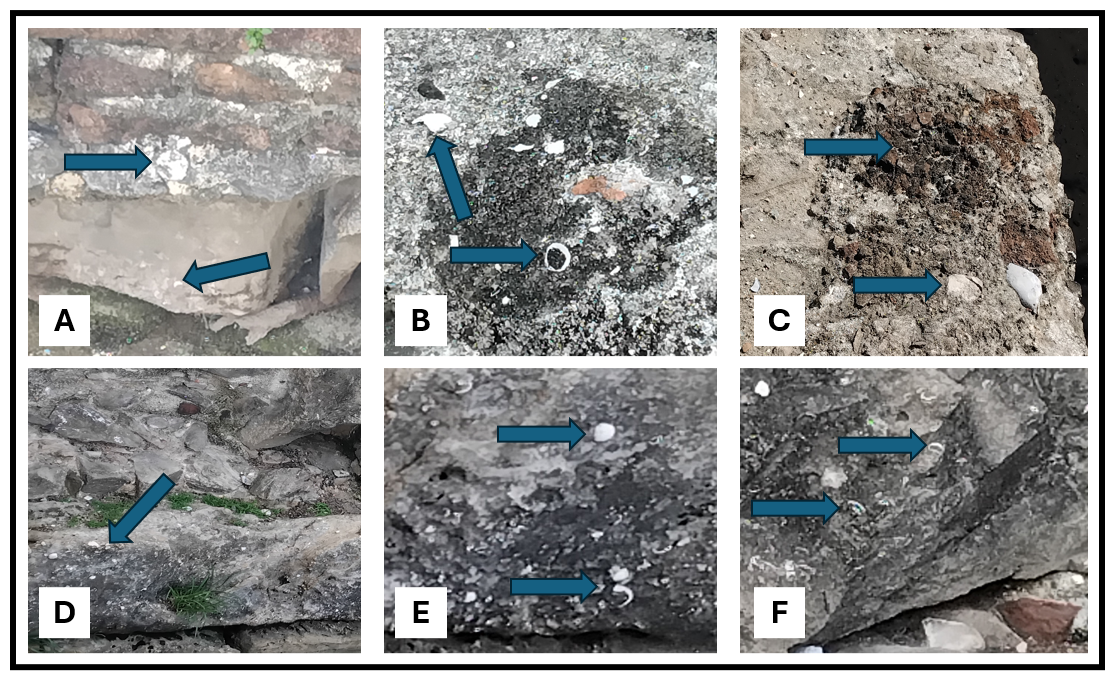
This difficulty in recognition is not limited to an isolated conceptual gap but is associated with long-standing historical processes that shaped Brazilian society’s relationship with reef environments, which were indiscriminately used as mineral resources for construction, as illustrated in Figure 1. In the context of the colonization of the northeastern coast, coral reefs and reef sandstones were systematically exploited as raw materials for building churches, military fortifications, housing, and port structures, being incorporated into the social imagination as mineral resources available for urban construction. This historical appropriation contributed to the naturalization of the perception of corals as “rock,” dissociating them of their biological and ecological condition.
Figure 1 – Details of the sandstone rocks used in the wall that protected the city of Recife/PE during the Dutch occupation in the 17th Century.
Source: own authorship, recorded with a smartphone on February, 2026.
This wall and the city gate of Recife are located between Rua do Bom and Rua Barão Rodrigues Mendes, heading towards Av. Alfredo Lisboa. The blue arrows indicate details such as the presence of marine mollusk shells (mostly shellfish) in images A, B, D, E, and F; and in image C, there is a highlight on coral remnants encrusted in the sandstone rocks.
Figure 1 presents a photographic record of a historic construction structure composed of reef material, evidencing the incorporation of marine bioconstruction into the colonial architectural heritage of the northeastern coast. Although the image does not allow quantitative inferences regarding the volume of extracted material, its visual analysis contributes to understanding the relationships between territorial occupation and biomineral exploitation of coral reefs. In this regard, the figure acts as an illustrative element that aids in problematizing the social perception of corals as stony structures, an aspect discussed throughout this study and relevant to understanding the historical invisibilization of these organisms in Biology education and confirmed by absence of this thematic in the textbooks studied.
Moreover, the records of the rocks used during the colonial period are an excellent example of contextualization and the Science, Technology, Society, and Environment (STSE) approach, integrating into the Cnidaria content a holistic view of the zoological importance of these living beings in Biology textbooks.
Nascimento and Lopes (2016) [83], in a study on the ports of the Northeast region during the colonial period from the 16th century onward, demonstrated through a map authored by João Teixeira Albernaz where the illustrated cartography of the villages of Recife and Olinda, the presence of coral barriers no longer existent today. They suggested that their removal was due to the development of the Port of Recife, considered the most important in the Brazilian colony due to its proximity to Europe. In another example of the use of corals and coastal sandstones, Ferrão-Santos (2021) [84], when analyzing the requalification of Tamandaré Fort on the southern coast of Pernambuco, conducted a historical review confirming that corals and sandstones were used as raw construction materials for the fortification. Ferrão-Santos (2021) [85] stated in his study that the acquisition of sandstone and coral blocks was difficult, as they had to be cut and transported at low tide across unstable terrain, and according to Pinheiro (2002) [86], this work was performed by enslaved people who were responsible for the edifices of Colonial Brazil.
Furthermore, I emphasize that this approach supports compliance with Law No. 10.639/2003, which mandates the teaching of African and Afro-Brazilian history and culture in Basic Education. Textbooks should be educational tools that contribute to the operationalization and enforcement of this law, which must be interdisciplinary and not restricted solely to disciplines such as Sociology, Philosophy, History, and Literature, for example.
Although traditional historiography often identifies Brazilwood (pau-brasil) as the first natural resource intensively exploited during the colonial period, this narrative tends to obscure the structural role played by corals and reefs in the material foundation of coastal cities. Unlike Brazilwood, whose exploitation occurred predominantly as an export commodity, corals were used locally as the physical base for territorial occupation, supporting churches, fortresses, and ports from the earliest colonial endeavors. From this perspective, it can be asserted that corals rank among the first natural resources systematically and continuously exploited in colonial Brazil, with direct impacts on marine biodiversity.
From a paradigmatic perspective, this social construction can be understood as an expression of the influence of the Cartesian paradigm on the production and circulation of scientific knowledge within schools. Studies by Aquino et al. (2024) [87] highlight paradigmatic conceptions of science guide how ecological phenomena are interpreted and represented, with reductionism associated with the Cartesian paradigm limiting the articulation among historical, social, and ecological dimensions of biological phenomena.
In this sense, the perception of corals as “stone” is not only a historical heritage but also the outcome of the didactic reproduction of fragmented approaches that privilege isolated morphostructural characteristics to the detriment of their socioenvironmental context. The research by Aquino et al. (2024)[88] demonstrates that different ecological themes are influenced by distinct paradigmatic frameworks, with reductionist approaches linked to the Cartesian paradigm and more contextualized perspectives associated with complexity.
Complementarily, Aquino et al. (2023) [89] indicate that shifting paradigmatic lenses in teaching practice enables the reinterpretation of historically naturalized environmental phenomena, favoring the overcoming of fragmented readings and the construction of contextualized understandings. Applied to the present study, this framework allows the interpretation of the historical erasure of corals in textbooks as a manifestation of a scientific paradigm internalized throughout formal education and reproduced in the organization of content.
8.1 ZOOLOGY TEACHING, COLONIALITY, AND KNOWLEDGE FRAGMENTATION
The predominance of a decontextualized approach to cnidarians in textbooks can be understood in light of a teaching model still strongly influenced by the Cartesian paradigm, which fragments knowledge into separate disciplines and disregards the interrelations among biology, history, geography, and society. This was identified in all textbooks. As discussed by Krasilchik (2019) [90], this model hinders the construction of an integrated view of science and limits the development of students’ critical thinking.
Furthermore, the recurrent choice of foreign examples, to the detriment of Brazilian reality, can be interpreted as an expression of the coloniality of knowledge, in which knowledge produced outside the country is hierarchized as more relevant or legitimate. All books depict images of foreign coral reefs, but when they include images of cnidarian species that occur in Brazil, only TB1 provides the proper zoological identification and identification of Brazilian origin or occurrence, even then in a way that is reduced to the red sea anemone and in a superficial manner. Therefore, there is no valorization of Brazilian biodiversity and scientific knowledge of cnidarian species in Brazil. This critique is reinforced by studies on zoology teaching in Brazil, which highlight the need to break with pedagogical practices that reproduce historical and epistemological silences [91].
In the case of cnidarians, this coloniality manifests not only in the selection of examples but also in the omission of fundamental historical processes, such as the biomineral exploitation of coral reefs in the Brazilian Northeast during the colonial period. The absence of this discussion in textbooks contributes to the invisibilization of historical environmental impacts associated with the construction of cities, churches, fortifications, and ports along the northeastern coast.
8.2 IMPLICATIONS FOR TEACHING BIOLOGY
The results of this study demonstrate that the teaching of cnidarians, as presented in the analyzed textbooks, lacks a more critical, contextualized, and interdisciplinary approach. The disconnection between biological content and the Brazilian historical and environmental contexts compromises the education of students capable of understanding the complexity of the relationships between society and nature.
Furthermore, awareness of the need to adopt a new paradigm—complexity—and decoloniality contributes to a holistic and critical education that complies with Law Nº. 10.639/2003 regarding the teaching of African, Afro-Brazilian, and Indigenous history and culture. None of the textbooks analyzed address themes that cater to the teaching of Afro-Brazilian and Indigenous history and culture. Furthermore, it is worth noting that this approach is traditionally restricted to the disciplines of History, Sociology, Philosophy, and Languages and Literature, when it should be applied to all disciplines. Authors who embrace this awareness tend to produce Biology textbooks that are more aligned with biological, environmental, human, social, and economic contextualization.
In this regard, it is essential that educational materials incorporate discussions linking the biology of cnidarians with the environmental history of the Brazilian coast, the exploitation of coral reefs, and the impacts of this exploitation on marine biodiversity. Such a perspective contributes not only to the valorization of Brazilian natural heritage but also to the construction of a scientific education committed to environmental justice, decoloniality, and the complexity of socioecological phenomena.
CONCLUDING REMARKS
The analysis revealed that the treatment of the phylum Cnidaria in high school Biology textbooks remains marked by descriptive, fragmented, and poorly contextualized approaches, contributing to the historical and environmental invisibility of Brazilian coral reefs. The absence of discussions about the biomineral exploitation of corals since the colonial period—a central process in the formation of northeastern coastal cities—reveals gaps that dialogue with broader dynamics of coloniality of knowledge and fragmentation of school scientific knowledge.
The results indicate that this silencing expresses a historical process of naturalizing corals as a mineral resource, contributing to the persistence of their perception as "stones." This construction highlights the articulation between environmental history, social imaginary, and the production of school knowledge, pointing to colonial and epistemological roots in the invisibility of these organisms.
From a theoretical point of view, the study reinforces the insufficiency of the Cartesian paradigm to understand complex socio-environmental phenomena, highlighting the potential of the complexity and decoloniality paradigm to interpret reefs as integrated socio-ecological systems. In the educational context, there is a clear need to overcome practices centered on memorization and taxonomy, incorporating approaches that articulate biology, environmental history, and contemporary conservation challenges. Such integration fosters critical science education and contributes to the fulfillment of Law No. 10.639/2003 by problematizing relationships between coloniality, enslaved labor, and the appropriation of natural resources.
Despite its contributions, the research presents limitations inherent to its documentary nature, not contemplating pedagogical mediation or the reception of the content by teachers and students. As future perspectives, it is recommended to expand the corpus, conduct empirical studies, and develop didactic proposals that integrate Brazilian biodiversity, environmental history, and complex and decolonial approaches.
Finally, it is reaffirmed that the teaching of Biology constitutes a space for the dispute of narratives and paradigms. Recognizing corals as historically exploited living organisms implies repositioning the teaching of cnidarians as a field of reflection on science, coloniality, and environmental justice.
REFERENCES
Ab’Sáber, Aziz. Os Domínios de Natureza no Brasil: Potencialidades Paisagísticas. 7th ed. Ateliê Editorial, 2021.
Alves, Nancy de Fátima Vasconcelos. “Conteúdos do tema Biologia Marinha em livros didáticos do Ensino Médio: descrevendo a realidade de algumas escolas na cidade de Cuité-PB.” Trabalho de Conclusão de Curso - TCC. Universidade Federal de Campina Grande - UFCG, 2014. https://dspace.sti.ufcg.edu.br/handle/riufcg/10008.
Amabis, José Mariano, and Gilberto Rodrigues Martho. Biologia Em Contexto: A Diversidade Dos Seres Vivos. 1st ed. Vol. 3. Moderna, 2013.
Aquino, Rafael Santos de. “Ensino de Ciências em cultura cruzada: a formação de conceitos em sala de aula multicultural em Salgueiro, Pernambuco, Brasil.” Doutorado, Universidade Federal Rural de Pernambuco, 2022. http://www.tede2.ufrpe.br:8080/tede2/handle/tede2/8708.
Aquino, Rafael Santos de, Rita Paradeda Muhle, Carmen Roselaine de Oliveira Farias, and Ana Maria dos Anjos Carneiro Leão. “Influences of Paradigmatic Conceptions of Science in Texts on Ecology of Undergraduates of Biology Sciences.” Educação Em Revista 40 (2024): e45194. https://doi.org/10.1590/0102-469845194-t.
Aquino, Rafael Santos de, Rita Paradeda Muhle, Carmen Roselaine de Oliveira Farias, and Ana Maria dos Anjos Carneiro Leão. “Mudança de lentes e a prática docente: o besouro da complexidade ecológica para uma análise paradigmática do componente curricular prática de ecologia na licenciatura em ciências biológicas.” Revista de Ensino de Biologia da SBEnBio, November 22, 2023, 452–74. https://doi.org/10.46667/renbio.v16inesp.1.1064.
Bezerra dos Santos, Juliana, Renato Amorim Da Silva, Anderson Thiago Monteiro Da Silva, and Ricardo Ferreira Das Neves. “Análise Imagética Do Filo Cnidaria Em Livros Didáticos de Biologia a Partir Da Teoria Cognitivista Da Aprendizagem Multimídia (TCAM).” Revista Thema 21, no. 4 (2023): 1122–40. https://doi.org/10.15536/thema.V21.2022.1122-1140.1979.
Bizzo, Nélio. Novas Bases Da Biologia: Seres Vivos e Comunidades. 1st ed. Vol. 2. Ática, 2011.
Brusca, Gary J. Invertebrados. With Richard C. Brusca. Guanabara Koogan, 2006.
Castro, Clovis B., and Débora O. Pires. “Brazilian Coral Reefs: What We Already Know and What Is Still Missing.” Bulletin of Marine Science 69, no. 2 (2001): 357–71.
Delizoicov, Demétrio, José André Angotti, and Marta Maria Pernambuco. Ensino de ciências: fundamentos e métodos. 5a ed. Cortez Editora, 2024.
Diegues, Antonio Carlos. O mito moderno da Natureza Intocada. 6th ed. Expressão Popular, 2008.
Ferrão Santos, Maria do Carmo. “A requalificação do Forte de Tamandaré (Pernambuco).” CLIO: Revista de Pesquisa Histórica 39, no. 1 (2021): 342–65. https://doi.org/10.22264/clio.issn2525-5649.2021.39.1.16.
Fracalanza, Hilário, Ivan Amorosino Do Amaral, and Mariley Simões Flória Gouveia. O ensino de Ciências no Primeiro Grau. Atual, 1986.
Francini-Filho, Ronaldo B., Nils E. Asp, Eduardo Siegle, et al. “Perspectives on the Great Amazon Reef: Extension, Biodiversity, and Threats.” Frontiers in Marine Science 5 (April 2018): 142. https://doi.org/10.3389/fmars.2018.00142.
Hetzel, Bia, Clóvis Barreira e Castro, and Zelinda M. Leão. Corals of Southern Bahia. Editora Nova Fronteira, 1994.
Jennerjahn, Tim C. “Biogeochemical Response of Tropical Coastal Systems to Present and Past Environmental Change.” Earth-Science Reviews 114, nos. 1–2 (2012): 19–41. https://doi.org/10.1016/j.earscirev.2012.04.005.
Krasilchik, Myriam. Prática de Ensino de Biologia. Edusp - Editora da Universidade de São Paulo, 2019.
Kuhn, Thomas Samuel. A estrutura das revoluções científicas. With Beatriz Vianna Boeira and Nelson Boeira. Debates. Perspectiva, 2020.
Leão, Zelinda M. A. N., Ruy K. P. Kikuchi, Beatrice P. Ferreira, et al. “Brazilian Coral Reefs in a Period of Global Change: A Synthesis.” Brazilian Journal of Oceanography 64, no. spe2 (2016): 97–116. https://doi.org/10.1590/S1679-875920160916064sp2.
Leão, Zelinda M. A. N., Ruy K. P. Kikuchi, and Viviane Testa. “Corals and Coral Reefs of Brazil.” In Latin American Coral Reefs. Elsevier, 2003. https://doi.org/10.1016/B978-044451388-5/50003-5.
Linhares, Sérgio, and Fernando Gewandsznajder. Biologia Hoje. 2nd ed. Vol. 2. Ática, 2013.
Lopes, Alice Casimiro, and Elizabeth Macedo. Currículo: Debates Contemporâneos. 3rd ed. Cortez Editora, 2015.
Lopes, Sônia. Bio. 1st ed. Único. Saraiva, 2004.
Louzada-Silva, Daniel, and Maria Helena da Silva Carneiro. Fotografia e diversidade biológica em livros didáticos de Biologia. (Sevilla), no. Extra (2013): 2018–23.
Mayer, Richard E., and Logan Fiorella, eds. The Cambridge Handbook of Multimedia Learning. 3rd ed. Cambridge University Press, 2021. https://doi.org/10.1017/9781108894333.
Megid Neto, Jorge, and Hilário Fracalanza. “O livro didático de ciências: problemas e soluções.” Ciência & Educação (Bauru) 9, no. 2 (2003): 147–57. https://doi.org/10.1590/S1516-73132003000200001.
Mendonça, Vivian Lúcia. Biologia: Os Seres Vivos. 2nd ed. Vol. 2. AJS, 2013.
Moberg, Fredrik, and Carl Folke. “Ecological Goods and Services of Coral Reef Ecosystems.” Ecological Economics 29, no. 2 (1999): 215–33. https://doi.org/10.1016/S0921-8009(99)00009-9.
Moore, Janet. Uma Introdução Aos Invertebrados. Santos, 2008.
Morin, Edgar. Introdução Ao Pensamento Complexo. 5th ed. Sulina, 2015.
Morin, Edgar. Os setes saberes necessários à educação do futuro. 2nd ed. Cortez Editora, 2018.
Nascimento, Ana, and Josué Lopes. Puertos y dinámica colonial: los principales puertos de las capitanías del norte de Brasil. no. 36 (2016): 87–96.
Nascimento, Pedro Henrique de Souza, and Letícia Cavassana Soares. “Aprendizagem significativa: utilização de imagens em livros didáticos de Biologia.” Revista Contemporânea de Educação 18, no. 41 (2023): 87–96. https://doi.org/https://doi.org/10.20500/rce.v18i41.50588.
Neves, Ricardo Ferreira das, Ana Maria dos Anjos Carneiro Carneiro-Leão, and Helaine Sivini Ferreira. “A Imagem Da Célula Em Livros de Biologia: Uma Abordagem a Partir Da Teoria Cognitivista Da Aprendizagem Multimídia.” Investigações Em Ensino de Ciências 21, no. 1 (2016): 94–105. https://doi.org/10.22600/1518-8795.ienci2016v21n1p94.
Pinheiro, Cláudio C. “No Governo Dos Mundos: Escravidão, Contextos Coloniais e Administração de Populações.” Estudos Afro-Asiáticos 24, no. 3 (2002): 425–57. https://doi.org/10.1590/S0101-546X2002000300001.
Projeto Coral Vivo. “Coral Vivo Responde.” Cartilha. Projeto Coral Vivo, July 1, 2022. https://coralvivo.org.br/wp-content/uploads/2022/07/Coral-Vivo-Responde_V2.pdf.
Quijano, Aníbal. Colonialidade do poder, eurocentrismo e América Latina. CLACSO, Consejo Latinoamericano de Ciencias Sociales, 2005. http://bibliotecavirtual.clacso.org.ar/clacso/sur-sur/20100624103322/12_Quijano.pdf.
Ramos, Carlos Amilton Lima, and Maria José Souza Pinho. “Análisis de imágenes relacionadas con el medio ambiente en los libros de texto de Biología.” Revista Multidisciplinar do Núcleo de Pesquisa e Extensão 4, no. 1 (2024): e202401.
Rodrigo L. Moura, Gilberto M. Amado-Filho, Fernando C. Moraes, et al. “An Extensive Reef System at the Amazon River Mouth.” Science Advances 2, no. 4 (2016): e1501252. https://doi.org/10.1126/sciadv.1501252.
Ruppert, Edward E. Zoologia Dos Invertebrados. With Richard S. Fox and Robert D. Barnes. Roca, 2005.
Souza, Harlan Felix de, Alex Antonio Brandão, Italo Roberto do Nascimento Araújo, Reynan Lucas de Lima Gomes, and Ricardo Ferreira das Neves. “As imagens fotográficas do filo cnidária em livros didáticos de Biologia do ensino médio: um olhar sobre educação em saúde.” Revista de Ensino de Biologia da SBEnBio, June 18, 2024, 194–215. https://doi.org/10.46667/renbio.v17i1.1224.
Steiner, Andrea Quirino, Fernanda Maria Duarte Amaral, João Renato De Barros Campos Do Amaral, Roberto Sassi, and Juliana Imenis Barradas. “Zonação de Recifes Emersos Da Área de Proteção Ambiental Costa Dos Corais, Nordeste Do Brasil.” Iheringia. Série Zoologia 105, no. 2 (2015): 184–92. https://doi.org/10.1590/1678-476620151052184192.
Uzunian, Arnaldo, and Ernesto Birner. Biologia. 3rd ed. Único. Harbra, 2008.
Vasconcelos, Simão Dias, and Emanuel Souto. “O livro didático de ciências no ensino fundamental proposta de critérios para análise do conteúdo zoológico.” Ciência & Educação (Bauru) 9, no. 1 (2003): 93–104. https://doi.org/10.1590/S1516-73132003000100008.
Walsh, Catherine E. Interculturalidad, Estado, Sociedad: Luchas (de)Coloniales de Nuestra Época. 1. ed. Universidad Andina Simón Bolívar, Ecuador : Abya-Yala, 2009.
Westmacott, Susie, Kristian Teleki, and Jordan West. Gestão de Recifes de Coral Branqueados Ou Severamente Danificados. IUCN, Gland, Switzerland and Cambridge, 2000. https://portals.iucn.org/library/sites/library/files/documents/2000-062-Pt.pdf.
Zocche, Elis Regina dos Reis, Darcy Alves Do Bomfim, and Flávia Andréia Fracaro Fracaro. “Análise dos conteúdos de Zoologia presentes nos livros didáticos de Biologia do PNLD 2018-2020.” Profiscientia, no. 15 (December 2023): 130–52. https://doi.org/10.61803/1806-0285.15.2021.160.
Las opiniones, análisis y conclusiones del autor son de su responsabilidad y no necesariamente reflejan el pensamiento de Revista Inclusiones. | |
[1] Myriam Krasilchik, Prática de Ensino de Biologia (Edusp - Editora da Universidade de São Paulo, 2019); Demétrio Delizoicov et al., Ensino de ciências: fundamentos e métodos, 5a ed. (Cortez Editora, 2024).
[2] Thomas Samuel Kuhn, A estrutura das revoluções científicas, with Beatriz Vianna Boeira and Nelson Boeira, Debates (Perspectiva, 2020).
[3] Fredrik Moberg and Carl Folke, “Ecological Goods and Services of Coral Reef Ecosystems,” Ecological Economics 29, no. 2 (1999): 215–33, https://doi.org/10.1016/S0921-8009(99)00009-9; Zelinda M. A. N. Leão et al., “Corals and Coral Reefs of Brazil,” in Latin American Coral Reefs (Elsevier, 2003), https://doi.org/10.1016/B978-044451388-5/50003-5.
[4] Aníbal Quijano, Colonialidade do poder, eurocentrismo e América Latina (CLACSO, Consejo Latinoamericano de Ciencias Sociales, 2005), http://bibliotecavirtual.clacso.org.ar/clacso/sur-sur/20100624103322/12_Quijano.pdf; Catherine E. Walsh, Interculturalidad, Estado, Sociedad: Luchas (de)Coloniales de Nuestra Época, 1. ed (Universidad Andina Simón Bolívar, Ecuador: Abya-Yala, 2009).
[5] Edgar Morin, Introdução ao Pensamento Complexo, 5th ed. (Sulina, 2015); Edgar Morin, Os setes saberes necessários à educação do futuro, 2nd ed. (Cortez Editora, 2018).
[6] Antonio Carlos Diegues, O mito moderno da Natureza Intocada, 6th ed. (Expressão Popular, 2008); Zelinda M. A. N. Leão et al., “Brazilian Coral Reefs in a Period of Global Change: A Synthesis,” Brazilian Journal of Oceanography 64, no. spe2 (2016): 97–116, https://doi.org/10.1590/S1679-875920160916064sp2.
[7] Gary J. Brusca, Invertebrados, with Richard C. Brusca (Guanabara Koogan, 2006).
[8] Edward E. Ruppert, Zoologia dos Invertebrados, with Richard S. Fox and Robert D. Barnes (Roca, 2005).
[9] Ruppert, Zoologia dos Invertebrados.
[10] Janet Moore, Uma Introdução aos Invertebrados (Santos, 2008).
[11] Leão et al., “Corals and Coral Reefs of Brazil.”
[12] Tim C. Jennerjahn, “Biogeochemical Response of Tropical Coastal Systems to Present and Past Environmental Change,” Earth-Science Reviews 114, nos. 1–2 (2012): 19–41, https://doi.org/10.1016/j.earscirev.2012.04.005.
[13] Ruppert, Zoologia dos Invertebrados.
[14] Susie Westmacott et al., Gestão de Recifes de Coral Branqueados ou Severamente Danificados (IUCN, Gland, Switzerland and Cambridge, 2000), https://portals.iucn.org/library/sites/library/files/documents/2000-062-Pt.pdf.
[15] Bia Hetzel et al., Corals of Southern Bahia (Editora Nova Fronteira, 1994).
[16] Alice Casimiro Lopes and Elizabeth Macedo, Currículo: Debates Contemporâneos, 3rd ed. (Cortez Editora, 2015); Krasilchik, Prática de Ensino de Biologia.
[17] Delizoicov et al., Ensino de ciências.
[18] Hilário Fracalanza et al., O ensino de Ciências no Primeiro Grau (Atual, 1986); Simão Dias Vasconcelos and Emanuel Souto, “O livro didático de ciências no ensino fundamental proposta de critérios para análise do conteúdo zoológico,” Ciência & Educação (Bauru) 9, no. 1 (2003): 93–104, https://doi.org/10.1590/S1516-73132003000100008.
[19] Lopes and Macedo, Currículo.
[20] Jorge Megid Neto and Hilário Fracalanza, “O livro didático de ciências: problemas e soluções,” Ciência & Educação (Bauru) 9, no. 2 (2003): 147–57, https://doi.org/10.1590/S1516-73132003000200001.
[21] Rafael Santos de Aquino, “Ensino de Ciências em cultura cruzada: a formação de conceitos em sala de aula multicultural em Salgueiro, Pernambuco, Brasil” (Doutorado, Universidade Federal Rural de Pernambuco, 2022), http://www.tede2.ufrpe.br:8080/tede2/handle/tede2/8708.
[22] Elis Regina dos Reis Zocche et al., “Análise dos conteúdos de Zoologia presentes nos livros didáticos de Biologia do PNLD 2018-2020,” Profiscientia, no. 15 (December 2023): 130–52, https://doi.org/10.61803/1806-0285.15.2021.160.
[23] Carlos Amilton Lima Ramos and Maria José Souza Pinho, “Análisis de imágenes relacionadas con el medio ambiente en los libros de texto de Biología,” Revista Multidisciplinar do Núcleo de Pesquisa e Extensão 4, no. 1 (2024): e202401; Harlan Felix de Souza et al., “As imagens fotográficas do filo cnidária em livros didáticos de Biologia do ensino médio: um olhar sobre educação em saúde,” Revista de Ensino de Biologia da SBEnBio, June 18, 2024, 194–215, https://doi.org/10.46667/renbio.v17i1.1224.
[24] Morin, Introdução ao Pensamento Complexo.
[25] Quijano, Colonialidade do poder, eurocentrismo e América Latina.
[26] Walsh, Interculturalidad, Estado, Sociedad.
[27] Diegues, O mito moderno da Natureza Intocada; Aziz Ab’Sáber, Os Domínios de Natureza no Brasil: Potencialidades Paisagísticas, 7th ed. (Ateliê Editorial, 2021).
[28] Diegues, O mito moderno da Natureza Intocada; Leão et al., “Corals and Coral Reefs of Brazil.”
[29] Moberg and Folke, “Ecological Goods and Services of Coral Reef Ecosystems”; Leão et al., “Brazilian Coral Reefs in a Period of Global Change.”
[30] Diegues, O mito moderno da Natureza Intocada; Leão et al., “Brazilian Coral Reefs in a Period of Global Change.”
[31] Leão et al., “Corals and Coral Reefs of Brazil”; Leão et al., “Brazilian Coral Reefs in a Period of Global Change.”
[32] Clovis B. Castro and Débora O. Pires, “Brazilian Coral Reefs: What We Already Know and What Is Still Missing,” Bulletin of Marine Science 69, no. 2 (2001): 357–71.
[33] Rodrigo L. Moura et al., “An Extensive Reef System at the Amazon River Mouth,” Science Advances 2, no. 4 (2016): e1501252, https://doi.org/10.1126/sciadv.1501252; Ronaldo B. Francini-Filho et al., “Perspectives on the Great Amazon Reef: Extension, Biodiversity, and Threats,” Frontiers in Marine Science 5 (April 2018): 142, https://doi.org/10.3389/fmars.2018.00142.
[34] Megid Neto and Fracalanza, “O livro didático de ciências”; Vasconcelos and Souto, “O livro didático de ciências no ensino fundamental proposta de critérios para análise do conteúdo zoológico.”
[35] Diegues, O mito moderno da Natureza Intocada; Leão et al., “Brazilian Coral Reefs in a Period of Global Change.”
[36] José Mariano Amabis and Gilberto Rodrigues Martho, Biologia em Contexto: A Diversidade dos Seres Vivos, 1st ed., vol. 3 (Moderna, 2013).
[37] Vivian Lúcia Mendonça, Biologia: os Seres Vivos, 2nd ed., vol. 2 (AJS, 2013).
[38] Nélio Bizzo, Novas Bases da Biologia: Seres Vivos e Comunidades, 1st ed., vol. 2 (Ática, 2011).
[39] Sérgio Linhares and Fernando Gewandsznajder, Biologia Hoje, 2nd ed., vol. 2 (Ática, 2013).
[40] Sônia Lopes, Bio, 1st ed., Único (Saraiva, 2004).
[41] Arnaldo Uzunian and Ernesto Birner, Biologia, 3rd ed., Único (Harbra, 2008).
[42] Vasconcelos and Souto, “O livro didático de ciências no ensino fundamental proposta de critérios para análise do conteúdo zoológico.”
[43] Vasconcelos and Souto, “O livro didático de ciências no ensino fundamental proposta de critérios para análise do conteúdo zoológico.”
[44] Quijano, Colonialidade do poder, eurocentrismo e América Latina; Walsh, Interculturalidad, Estado, Sociedad.
[45] Morin, Introdução ao Pensamento Complexo.
[46] Vasconcelos and Souto, “O livro didático de ciências no ensino fundamental proposta de critérios para análise do conteúdo zoológico.”
[47] Nancy de Fátima Vasconcelos Alves, “Conteúdos do tema Biologia Marinha em livros didáticos do Ensino Médio: descrevendo a realidade de algumas escolas na cidade de Cuité-PB,” Trabalho de Conclusão de Curso - TCC, Universidade Federal de Campina Grande - UFCG, 2014, https://dspace.sti.ufcg.edu.br/handle/riufcg/10008; Ricardo Ferreira das Neves et al., “A Imagem da Célula em Livros de Biologia: uma abordagem a partir da Teoria Cognitivista da Aprendizagem Multimídia,” Investigações em Ensino de Ciências 21, no. 1 (2016): 94–105, https://doi.org/10.22600/1518-8795.ienci2016v21n1p94.
[48] Juliana Bezerra dos Santos et al., “Análise imagética do Filo Cnidaria em Livros Didáticos de Biologia a partir da Teoria Cognitivista da Aprendizagem Multimídia (TCAM),” Revista Thema 21, no. 4 (2023): 1122–40, https://doi.org/10.15536/thema.V21.2022.1122-1140.1979.
[49] Bezerra dos Santos et al., “Análise imagética do Filo Cnidaria em Livros Didáticos de Biologia a partir da Teoria Cognitivista da Aprendizagem Multimídia (TCAM).”
[50] Neves et al., “A imagem da célula em livros de biologia.”
[51] Quijano, Colonialidade do poder, eurocentrismo e América Latina; Walsh, Interculturalidad, Estado, Sociedad.
[52] Projeto Coral Vivo, “Coral Vivo Responde,” Cartilha, Projeto Coral Vivo, July 1, 2022, https://coralvivo.org.br/wp-content/uploads/2022/07/Coral-Vivo-Responde_V2.pdf.
[53] Neves et al., “A imagem da célula em livros de biologia.”
[54] Vasconcelos and Souto, “O livro didático de ciências no ensino fundamental proposta de critérios para análise do conteúdo zoológico.”
[55] Megid Neto and Fracalanza, “O livro didático de ciências”; Zocche et al., “Análise dos conteúdos de Zoologia presentes nos livros didáticos de Biologia do PNLD 2018-2020.”
[56] Alves, “Conteúdos do tema Biologia Marinha em livros didáticos do Ensino Médio: descrevendo a realidade de algumas escolas na cidade de Cuité-PB”; Bezerra dos Santos et al., “Análise imagética do Filo Cnidaria em Livros Didáticos de Biologia a partir da Teoria Cognitivista da Aprendizagem Multimídia (TCAM).”
[57] Lopes and Macedo, Currículo.
[58] Daniel Louzada-Silva and Maria Helena da Silva Carneiro, Fotografia e diversidade biológica em livros didáticos de Biologia, (Sevilla), no. Extra (2013): 2018–23.
[59] Souza et al., “As imagens fotográficas do filo cnidária em livros didáticos de Biologia do ensino médio.”
[60] Ramos and Pinho, “Análisis de imágenes relacionadas con el medio ambiente en los libros de texto de Biología.”
[61] Bezerra dos Santos et al., “Análise Imagética Do Filo Cnidaria Em Livros Didáticos de Biologia a Partir Da Teoria Cognitivista Da Aprendizagem Multimídia (TCAM).”
[62] Richard E. Mayer and Logan Fiorella, eds., The Cambridge Handbook of Multimedia Learning, 3rd ed. (Cambridge University Press, 2021), https://doi.org/10.1017/9781108894333.
[63] Souza et al., “As imagens fotográficas do filo cnidária em livros didáticos de Biologia do ensino médio.”
[64] Ana Nascimento and Josué Lopes, Puertos y dinámica colonial: los principales puertos de las capitanías del norte de Brasil, no. 36 (2016): 87–96.
[65] Louzada-Silva and Silva Carneiro, Fotografia e diversidade biológica em livros didáticos de Biologia.
[66] Souza et al., “As imagens fotográficas do filo cnidária em livros didáticos de Biologia do ensino médio.”
[67] Pedro Henrique de Souza Nascimento and Letícia Cavassana Soares, “Aprendizagem significativa: utilização de imagens em livros didáticos de Biologia,” Revista Contemporânea de Educação 18, no. 41 (2023): 87–96, https://doi.org/https://doi.org/10.20500/rce.v18i41.50588.
[68] Vasconcelos and Souto, “O livro didático de ciências no ensino fundamental proposta de critérios para análise do conteúdo zoológico.”
[69] Neves et al., “A imagem da célula em livros de biologia”; Bezerra dos Santos et al., “Análise imagética do Filo Cnidaria em Livros Didáticos de Biologia a partir da Teoria Cognitivista da Aprendizagem Multimídia (TCAM).”
[70] Vasconcelos and Souto, “O livro didático de ciências no ensino fundamental proposta de critérios para análise do conteúdo zoológico.”
[71] Andrea Quirino Steiner et al., “Zonação de Recifes emersos da Área de Proteção Ambiental Costa Dos Corais, Nordeste do Brasil,” Iheringia. Série Zoologia 105, no. 2 (2015): 184–92, https://doi.org/10.1590/1678-476620151052184192.
[72] Quijano, Colonialidade do poder, eurocentrismo e América Latina; Walsh, Interculturalidad, Estado, Sociedad.
[73] Bezerra dos Santos et al., “Análise imagética do Filo Cnidaria em livros didáticos de biologia a partir da Teoria Cognitivista da Aprendizagem Multimídia (TCAM).”
[74] Neves et al., “A imagem da célula em livros de biologia.”
[75] Vasconcelos and Souto, “O livro didático de ciências no ensino fundamental proposta de critérios para análise do conteúdo zoológico.”
[76] Bezerra dos Santos et al., “Análise imagética do Filo Cnidaria em livros didáticos de biologia a Partir da Teoria Cognitivista da Aprendizagem Multimídia (TCAM).”
[77] Neves et al., “A imagem da célula em livros de biologia.”
[78] Alves, “Conteúdos do tema Biologia Marinha em livros didáticos do Ensino Médio: descrevendo a realidade de algumas escolas na cidade de Cuité-PB.”
[79] Quijano, Colonialidade do poder, eurocentrismo e América Latina; Walsh, Interculturalidad, Estado, Sociedad.
[80] Vasconcelos and Souto, “O livro didático de ciências no ensino fundamental proposta de critérios para análise do conteúdo zoológico.”
[81] Projeto Coral Vivo, “Coral Vivo Responde.”
[82] Projeto Coral Vivo, “Coral Vivo Responde.”
[83] Nascimento and Lopes, Puertos y dinámica colonial: los principales puertos de las capitanías del norte de Brasil.
[84] Maria do Carmo Ferrão Santos, “A requalificação do Forte de Tamandaré (Pernambuco),” CLIO: Revista de Pesquisa Histórica 39, no. 1 (2021): 342–65, https://doi.org/10.22264/clio.issn2525-5649.2021.39.1.16.
[85] Ferrão Santos, “A requalificação do Forte de Tamandaré (Pernambuco).”
[86] Cláudio C. Pinheiro, “No Governo dos Mundos: Escravidão, Contextos Coloniais e Administração de Populações,” Estudos Afro-Asiáticos 24, no. 3 (2002): 425–57, https://doi.org/10.1590/S0101-546X2002000300001.
[87] Rafael Santos de Aquino et al., “Influences of Paradigmatic Conceptions of Science in Texts on Ecology of Undergraduates of Biology Sciences,” Educação Em Revista 40 (2024): e45194, https://doi.org/10.1590/0102-469845194-t.
[88] Aquino et al., “Influences of Paradigmatic Conceptions of Science in Texts on Ecology of Undergraduates of Biology Sciences.”
[89] Rafael Santos de Aquino et al., “Mudança de lentes e a prática docente: o besouro da complexidade ecológica para uma análise paradigmática do componente curricular prática de ecologia na licenciatura em ciências biológicas,” Revista de Ensino de Biologia da SBEnBio, November 22, 2023, 452–74, https://doi.org/10.46667/renbio.v16inesp.1.1064.
[90] Krasilchik, Prática de Ensino de Biologia.
[91] Vasconcelos and Souto, “O livro didático de ciências no ensino fundamental proposta de critérios para análise do conteúdo zoológico”; Alves, “Conteúdos do tema Biologia Marinha em livros didáticos do Ensino Médio: descrevendo a realidade de algumas escolas na cidade de Cuité-PB.”